WHAT PARENTS NEED TO KNOW ABOUT DATA CENTERS
In a recent op-ed, Executive Director of American Parents Coalition, Alleigh Marré highlighted legitimate concerns parents and families have with legacy data centers and how a lack of communication has left families in the lurch. While in some cases issues have been legitimate, there are also opportunities for this infrastructure to offer real benefits to communities if data center developers can improve transparency, communication, and meet residents at the negotiating table.

Every family understands that being part of a community comes with both benefits and responsibilities. We work together to keep our neighborhoods safe, support strong schools and essential services, and protect the shared resources we all depend on. These are the standards we expect, and we should expect the same from the businesses operating in our communities.
So where do data centers land on these standards?

THE BAD
Many of the things you hear about data centers was, or is, true in some form. As recent as last year, reports in Virginia stated legacy data centers collectively consumed more than 2 billion gallons of water through open-loop cooling systems that pulled directly from local drinking supplies. In Wisconsin, a data center developer was sued by local residents over what was described in the complaint as “unreasonable and excessive noise.” According to a Washington Post report from 2025, several cities across the U.S. saw increases to their utility bills due to factors that included data centers.
This is the most common thing families hear – concerns about water, noise, and power. It has dominated our social media and local news. It turns out, this negative reporting is forcing the industry to adjust and things are beginning to change for the better.
THE GOOD
A growing number of modern data centers are being built with families in mind by recycling water, investing in power infrastructure, and building real partnerships with the communities that host them. They do this through updated systems in which water is filled once and reused, by bringing, buying, or building energy resources, and taking steps to minimize noise. Additionally, across the country, data centers have also become significant contributors to the communities where they operate.
In DeKalb, Illinois, a data center project paid $48.5 million in property taxes between 2021 and 2024, helping fund city services and public schools, including revenue that allowed the local school district to build a new elementary school. In Virginia, tax revenue generated by a Mecklenburg County data center helped support a more than $150 million project to rebuild the county’s middle and high school complex, while the county plans additional investments in three new elementary schools. And in Maiden, North Carolina, a data center increased the tax base of the roughly 3,000-person community enough to help fund a new city hall and fire station. These benefits can extend beyond tax revenue with data center companies funding STEM education, workforce training, libraries, parks, community organizations, and other local initiatives in communities across the country.
THE DATA CENTER CRITERIA YOU SHOULD KNOW
So how do you know if you’re getting a good data center or a bad data center? Here is criteria that can help.
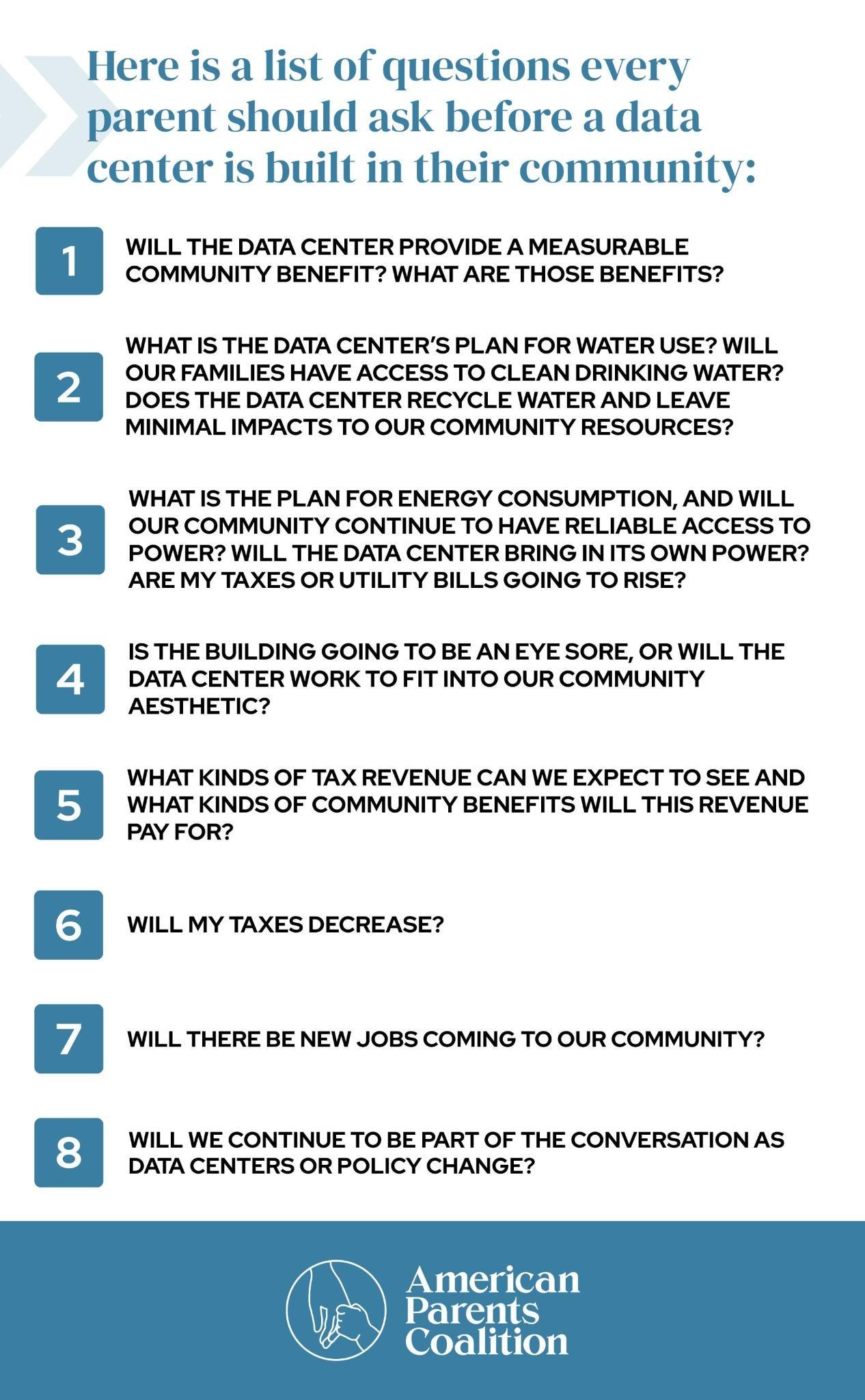
- Does It Deliver Measurable Community Benefit?
A modern data center doesn’t ask a community to simply trust it. It shows up with specific, verifiable commitments such as new tax revenue, and financial investments in the community, funded infrastructure that is ascetically pleasing to communities.
For example, in Loudoun County, Virginia, data centers account for 38 percent of the county’s general fund revenue despite occupying only about 4 percent of commercial land, helping fund schools, public safety, and the lowest real property tax rate in Northern Virginia. In Midlothian, Texas, a data center facility has invested more than $1.6 billion in the region since 2019, funding STEM grants, a youth suicide prevention program, and a new public library for the city. These are the kind of measurable, auditable benefits families should expect.
- What Are Its Plans for Water?
Water usage is a top concern when it comes to data centers. Families want to ensure that when they turn on their faucet, they will have access to safe drinking water. This concern about water was driven by legacy data centers that operate with open-loop cooling systems that lose roughly 70 to 80 percent of their water to evaporation. However, many modern data centers have moved to closed-loop systems that recycle the same water repeatedly and have almost no wasted water.
In Boydton, Virginia, one facility’s outdoor-air evaporative cooling system eliminates the need for cooling water roughly 85 percent of the year. Solutions like closed-loop cooling systems already exist and operate at scale and is a simple solution to ensure water is always available and not a concern.
- Is It Transparent About Power?
Families and communities do not want to see their energy bills rise when a new data center comes into their town. They also do not want to see their taxes increase to support a data center. These concerns are valid and there are various ways a modern data center can address these. For example, in Texas a company invested more than $10 billion in data center developments which included adding more than 5,000 megawatts to the Texas energy grid. In Missouri, another data center investment will include $20 million to support programs that will drive down monthly bills for families.
These investments in energy production follow, President Trump’s “Ratepayer Protection Pledge,” a pledge from companies building out data center infrastructure to protect families from footing the bill for data center energy consumption. President Trump’s “Build, Bring, Buy” pledge suggests companies build, bring, or buy their own energy resources and pay the full cost of these to ensure communities are not disproportionately affected.
States are also proactively protecting families from higher energy costs. The Texas legislature introduced Senate Bill 6 which requires large power users like data centers to fund their own infrastructure upgrades, allow for remote disconnection during grid emergencies, and register their backup generators, keeping costs and reliability risks on the data centers not on families. In 2025, Texas Governor Abbott signed this into law.
- Is It Being a Good Neighbor?
Finally, a modern data center minimizes its impact on the people who live around it, sharing its plans for water and energy use and fitting into the community rather than disrupting it. In Ellendale, North Dakota, one operator prioritized being a good neighbor by installing a closed-loop water system. This data center in Ellendale generated $3.5 million in tax revenue in the first seven months alone. This is a significant increase from the previous $400,000 in annual sales tax revenue the town was producing before the data center. In a recent opinion piece, Emily Hoeven said Ellendale “can now afford to repave its streets,” undertake needed renovations, “finance a new public-safety complex,” and “refurbish its historic opera house.” In Loudoun County, data centers are expected to generate $1.3 billion in tax revenue in 2027. According to reporting, this income allowed the county to cut residential property taxes by 30%, fund a new recreation center, build two new schools, and expand fire and other emergency services.
FINAL THOUGHT
Families shouldn’t be left guessing about how data centers will impact where they live. Parents have enough to worry about. If data centers are transparent in how they plan to develop the infrastructure and clearly communicate the community benefits families will receive, this will go a long way to build communities everyone can thrive in. Still, it’s important for parents to be armed with accurate information so you can decipher the fact from fiction, and the good from the bad.
TIPS FOR PARENTS
ENSURE DATA CENTERS ARE TRANSPARENT
Companies, local officials, and state lawmakers have an obligation to educate families about development and new infrastructure in their cities and towns to ensure these data centers are providing benefits and fulfilling their responsibility to keep communities thriving.
Data Centers are not going to disappear – so don’t get caught flat-footed. Attend local meetings in your community, join online groups to discuss the pros and cons, and talk about what you’re learning with your friends and neighbors.
OTHER NEWS YOU NEED TO KNOW
ALLEIGH MARRÉ ARGUES FAMILIES NEED STRAIGHT ANSWERS ON DATA CENTERS: An op-ed by Executive Director Alleigh Marré argues data centers can bring real benefits to communities, but open dialogue between industry and residents is key to understanding the effects. Read more here.
AMERICAN PARENTS COALITION LAUNCHES GUIDE TO CHECK PEDIATRICIANS’ AAP MEMBERSHIP: American Parents Coalition released new resources showing families if their child’s pediatrician is a member or fellow of the American Academy of Pediatrics which promotes dangerous gender ideology. Read more here.
OP-ED ON HOW DATA CENTERS FUEL Y’ALL STREET: An op-ed by Mike Martin, president of NavStrategies and former senior White House official, outlines how data centers power Y’all Street as Texas thrives financially. Read more here.
VA GOV. SPANBERGER ENDS PROTECTIONS FOR GIRLS’ SPORTS AND SPACES: Virginia Governor Spanberger quietly killed a rule that would have protected girls by dividing sports and spaces by biological sex instead of allowing gender ideology. Read more here.
FCC QUESTIONS CHILDREN’S TV PROGRAMS FOR GENDER IDEOLOGY: Numerous children’s television programs are under scrutiny for their content. The FCC is questioning whether the current ratings system adequately identifies themes including gender ideology for families. Read more here.
DEPARTMENT OF EDUCATION UPHOLDS TITLE IX PROTECTIONS: The U.S. Department of Education rescinded President Biden’s illegal rewrite of Title IX ensuring opportunities for girls are protected, not erased. Read more here.
Thanks for reading the latest edition of the American Parents Coalition’s The Lookout. If you have a troubling story to share about a school, doctor, company, or other institution working to usurp parents’ rights, please let us know by emailing us at outreach@americanparentscoalition.org.